Our Spotlight Team’s examination of the lounge side of the moon concludes with an Englishman who is usually categorized as “blue-eyed soul” (like The Righteous Brothers) but who is actually a much more complicated man (like Shaft).
500bc2ee36eee59292918d8b54a94663_1000x975x1.jpg
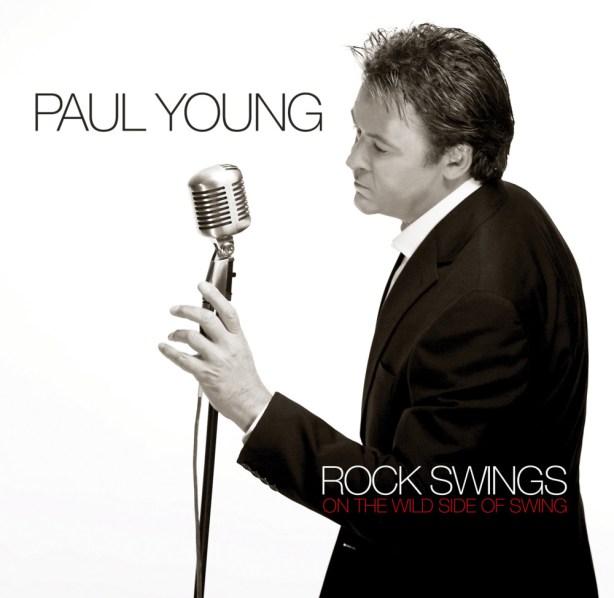
Rock Swings: On the Wild Side of Swing released in 2006

Paul Young had several easy-listening hits in the U.K. in the 1980s and one in the U.S., “Every Time You Go Away,” a Hall & Oates cover, in 1985. Looking back, I can hear his expertise as an interpreter of pop and R&B, but in those years I paid no attention to him. I was probably too busy with Duran Duran.

Young has overcome health crises that at times robbed him of his voice. He’s been committed to his music for more than 40 years. (He also built a back-up career as a celebrity chef.) He seems to be the kind of person who lives to try something new, as in 2006 when he followed Paul Anka’s lead and recorded Vegas interpretations of rock songs.

Young has a beautiful voice that has significantly deepened since he was 29 and looked like a stunt double for somebody in Wham! or Spandau Ballet. His voice reminds me of Lou Rawls’, though it’s not as deep and smoky. He sings without trying to sound black; Paul Young is always Paul Young. And unlike Pat Boone, this man is built for a swingin’ set of rock ’n’ roll.

Unfortunately, on Rock Swings: On the Wild Side of Swing, Young can’t decide to love or laugh at these songs. He’s not a Richard Cheeseball, but most of these covers don’t work – for example, Elton John’s “Benny and the Jets,” which is like a marching band crashing a funeral, or Lou Reed’s “Walk on the Wild Side,” which is neither wild nor walkable.

Two songs redeemed this disc…

Pat Boone covered Metallica’s “Enter Sandman” on I’m in a Metal Mood, but he didn’t know what to do with this nightmare on Elm Street. Richard Cheese attacked it on Aperitif for Destruction, but I hit Skip inside the first minute. On Rock Swings, Young captures the horror. It’s an adolescent’s idea of horror – look who wrote it – but he captured it just the same.

(“Enter Sandman” ties “Black Hole Sun” for the most popular number among lounge singers – reinterpreted three times each. Why? The two songs are nothing like each other, except that all the people who originally performed them had terrible hair.)

Young also covers David Bowie’s “The Jean Genie.” He’s the only man in this foursome to try on some Bowie. (Cheese covered “Under Pressure,” but that’s a Queen song co-written by Bowie.) His cover swings like the Tommy Dorsey Orchestra commuting to work on jungle vines.

…and one song escaped it

I don’t spend much time listening to Eminem. In fact, I don’t spend any time listening to Eminem. “Lose Yourself,” an 800-word essay on becoming a star, was a blank to me.

On his cover of “Lose Yourself,” Young reimagines himself as the rapper, though they’re from radically different generations and cultures. The one man’s voice and the other man’s words had me at hello:

Look, if you had one shot, one opportunity
To seize everything you ever wanted
One moment
Would you capture it or just let it slip?

The arrangement is stellar, the kind of thing that Nelson Riddle would’ve whipped up for a Sinatra showstopper. The producer doubles Young’s stunning vocal so that he’s singing back-up for himself, but the producer also dropped words at random from this backing track. Young singing the lead while his duplicate appears and disappears behind him produces a staccato effect that makes it sound as if he’s singing and rapping the lyrics at the same time.

Eminem’s words must have spoken to something in Paul Young’s DNA:

You better lose yourself in the music, the moment
You own it, you better never let it go
You only get one shot, do not miss your chance to blow
This opportunity comes once in a lifetime

And when Young gets to the spoken-word part, you can believe it when he says “motherfuckin’.” This is so not Pat Boone observing, “Yeah, we’re runnin’ a little bit hot tonight,” while wandering aimlessly inside Van Halen’s “Panama.”

Young’s Rock Swings doesn’t have anywhere near the overall consistency of Paul Anka’s Rock Swings, but “Lose Yourself” is the brightest, sharpest gem of all the music I’ve been writing about this week.

Eminem’s original is not bad, but he’s no Paul Young.

Thanks for reading along, and I hope you now find yourself ready to engage with compelling Vegas-based content. Go easy on the martinis and don’t be a stranger in the night.


To prolong the suspense, or the agony, of our Spotlight Team’s series on lounge versions of pop songs, we pause tonight to consider the question Frank Sinatra would surely ask if he were still with us: How am I supposed to swing with the broads when it’s nothin’ but lugs in here?

Excellent question, Mr. Chairman. We have only a small pool of data to work with, but so far every practitioner of this strange art has been a white male. (The gentleman I’ll introduce tomorrow doesn’t break the pattern.) Where are the women? Why can’t we have an album of swinging rock music by Diana Krall or Cassandra Wilson?

Possible explanations: The women are not interested. They’re not nerds. The music is weird. They have better things to do. They don’t want to record an album of rock or hip-hop in the Las Vegas style and then have millions of middle-aged male trolls whine on Twitter that “You’ve stolen my childhood!”

There’s yet another question that Sinatra wouldn’t have thought of asking – Why is it that Pat Boone, Paul Anka, Richard Cheese, and tomorrow’s guest, who are all men, only cover songs by men? – but I don’t have an answer and frankly that’s quite enough diversity for tonight. Equality takes time, female readers, especially when you’re a male.

(Just to be fair: Cheese covered Madonna’s “Material Girl.” Isn’t that enough?)

Let’s check the inbox

When my friend Paul appeared on NPR after his first book was published, he quickly eviscerated the caller with the opening question. “That’ll teach her to participate,” he told me later.

It is with a similarly generous spirit that I turn to a just-received comment from a Mr. Jerry Kaufman of Seattle, Washington. Jerry and I met in a trench outside of Sevastopol during the Crimean War. The British accused Jerry of colluding with the Russians, but I just laughed. I knew he was good-bad but not evil.

At the time of our meeting, Jerry was an advanced music fan with a record collection I envied and who was about to form a New Wave or No Wave band called Pictures of Vegetables. You can tell right there that he and his bandmates (they might not all have known that they were his bandmates) cared not a bit for commercial success. I would’ve changed at least three words in that name, but then I’m a crass person who has a love-hate relationship with money.

Jerry writes: “So have you listened to a band called Nouvelle Vague? They do lounge covers of 1970s and 1980s songs (for example, ‘Blister in the Sun’).”

Excellent! A band I had never heard of. However, this collective of sexy French people plays bossa nova, not lounge. If you like Brazilian pop – even Frankie did – you’ll enjoy their debut album, Nouvelle Vague (2004), though I got tired of them messing around with their tricks a ways before the 14 tracks ended.

The highlights for me were The Clash’s “Guns of Brixton,” Modern English’s “I Melt with You,” The Undertones’ “Teenage Kicks” (one of my favorite songs), and the song that never fails to make me turn my head to hide my tears, The Dead Kennedys’ “Too Drunk to Fuck,” which sounds far better than the original when the lyrics are sung with a French accent.

Thank you for writing in, sir.

Tomorrow: We’re done!


This is Part III of our investigation of Las Vegas and what the Rat Pack can do with rock ’n’ roll. Tonight the Spotlight Team revisits a record I reviewed in 2013.

41P8JBMRHVL
Rock Swings released in 2005

Here’s what I said:

I respect Paul Anka for his creativity; he wrote for Buddy Holly and Frank Sinatra, and how many people can say that? But Anka is also responsible for three crimes against humanity: “Put Your Head on My Shoulder,” “Puppy Love,” and the ultimate in offensiveness at the molecular level, “(You’re) Having My Baby.”

I stand by this statement, but after five years of thinking it over (I had nothing else to do), I must make two emendations:

1) The more I learn about Paul Anka, the more impressed I become. He’s recorded 45 albums, which puts him ahead of The Rolling Stones, Santana, The Muppets, and even Mannheim Steamroller. He’s been a success since I was a baby, and I was a baby when Athens fought Sparta in the Peloponnesian War, and also based on things my parents have said I believe I wasn’t a success being a baby.

2) I wrote that Rock Swings “just slips in as a Buy.” As we say in the porn biz, “This is so wrong.” I’ve learned to appreciate this record. I’ve learned to love this record. This is a fun record! It’s not only the best overall example of all this lounging around in the rock arena; if I had to make a list of the 50 best albums of the ’00s, Rock Swings would be 49th or 50th. (Full disclosure: I only know about 50 albums from the ’00s.)

I don’t know if Anka modeled any part of his career on Sinatra, but I’m convinced that if Sinatra had ever decided to play the same game as Pat Boone and Richard Cheese, the result would’ve been very close to Rock Swings.

And yet Rock Swings, as superb as it is, does not provide the ultimate thrill of this weird, lonely rock-as-lounge genre. Nor does it answer this question: Can you enjoy these covers if you’ve never heard the originals? Because up until this point, I knew almost all the originals.

In Part IV, we unveil the man and the mystery song that punctured the blood-brain barrier and inspired my co-workers to insist I wear headphones.

Soundgarden trivia

Soundgarden’s “Black Hole Sun” was covered by Steve Lawrence and Eydie Gormé, Paul Anka, and, of course, Richard Cheese, making it the single most popular tune among Vegas-style crooners. I can see why Pat Boone passed on it – he was doing metal covers, and in 1997, Soundgarden wasn’t metal, it was grunge. That distinction is meaningless today. But the song is about as speedy as a 15-year-old retired corgi. It was perfect for Pat.


In Part II of our series on rock and other genres poured through the coffee filter of what I’m loosely calling “lounge,” our Spotlight Team turns to the man who believes he’s cheddar, the singular most popular cheese in the world, when he’s not even Venezuelan beaver cheese and in fact the van broke down ages ago: Mark Jonathan Davis, better known as Richard Cheese.

RC-LOGO-VEGAS-PREMASTER.jpgLounge Against the Machine (2000), Tuxicity (2003), Aperitif for Destruction (2005), I’d Like a Virgin (2006), OK Bartender (2010), Supermassive Black Tux (2015), and too many more to fuck with

Cheese’s raison d’etre is to sing lounge versions of songs that are tasteless (Nirvana’s “Rape Me”), anything with an impolite word (Radiohead’s “Creep,” Prodigy’s “Smack My Bitch Up”*), songs that can be rearranged in preposterous ways (U2’s “Sunday Bloody Sunday” rewired as a cha-cha), or songs that were already dumb when they were hatched (Nena’s “99 Luftballoons”).

* I am thankful that “Smack My Bitch Up” only has eight words. (The other four are “Change my pitch up.”) The eight words are credited to five writers, which sounds like the writing credits to the typical Star Trek movie.

Weird Al makes up new lyrics for existing songs to express his own ideas. Cheese lets the existing lyrics speak for themselves by setting them in this fake Vegas tiara. After four or five cuts on the first album you’ve basically heard everything he’s going to give you in the next hundred, but he does have some surprises up his cummerbund. His cover of “Only Happy When It Rains” by Garbage is serious and almost emotional. That’s a tsunami in a shot glass for Cheese.

Cheese’s voice is above average, but it’s brassy, without much nuance. He can growl, sort of, but he never loses his passing vocal resemblance to Steve Martin. His arrangements are for small groups of musicians who can really swing, and I like how he compresses almost everything into a 2-minute formula so you’re never marooned in his shtick for long. His best cuts are his covers of “Creep” (clever) and Coldplay’s “Yellow” (hilarious). His jazz arrangement of Depeche Mode’s “Personal Jesus” has some voltage. However, his real contributions to popular culture are his album titles.

There’s not much call for Richard Cheese around these parts, and if in fact he ever infiltrates our place of residence I hope the dog eats him.

Consumer note

If you ever see Cheese live: He’s sick and tired of people yelling “Free Bird!” at his concerts. Be sure you yell it.

Coming up in Parts III and IV: People who sing like they mean it.


gang

Plenty of classical and jazz musicians have crossed over to rock ’n’ roll, but not many crooners. Where are the interpreters in the style of Frank Sinatra, Dean Martin, Ella Fitzgerald, and Tony Bennett?

There’s a stream of jazz musicians interpreting rock today, and as for classical musicians, that stream is a Class 5 whitewater adventure. You can’t swing a sackbut in a concert hall without hitting yet another eager band of classical musicians who are ready to step up and throw down: 2Cellos, The Harp Twins, The Vitamin String Quartet, and, my favorite, Bella Electric Strings.

Qualifications for membership in Bella Electric Strings:

1. Must be white, female, and under 30
2. Must dislike food
3. Must play the violin

But who is performing the rock (and hip-hop) repertoire in a lounge/swing style? In this, Part I of a four-part investigation by our Spotlight Team, we look at our first competitor: Pat Boone.

fc542b7fa44e764484089354d628d34aa1c68eb7
In a Metal Mood released in 1997

Boone, who made his reputation defusing black music for white teenagers in malt shops, goes for broke on 12 hard-rock classics, from Judas Priest to Led Zep. Sorry, Pat, no sale. The 1950s big-band arrangements and the chorus of women from the lite-rock channel are silly. Boone’s voice isn’t suited to this work; it’s smooth, seamless, and not at all steamy. Mitt Romney could’ve recorded this disc.

Of the 12 songs here, Dio’s “Holy Diver” works best as a bouncy lounge number, but Boone’s bland voice gets in the way. He doesn’t do too badly with Nazareth’s “Love Hurts”; the original moved at a Boone-like stroll. Unfortunately, that lack of speed makes the original and the cover boring.

His version of Van Halen’s “Panama” achieves some warmth, probably because Van Halen gave us a show tune with killer guitars. But when he gets to the spoken-word part about driving a car on a hot night and reaching down between his legs, he reminds you that he’s Pat Boone.

In a Metal Mood is not bad for a man who released his first record way back in 1956 (it was called Howdy!, the most inoffensive title in the history of titles), but, also, not good. I will say this for Pat: I’m convinced he was serious when he conceived this project. Plus he’s got titanium balls (though no common sense) for covering Metallica and Jimi Hendrix.

Am I experiencing a jab of guilt, or is it just an undigested bit of beef?

Sometimes even Run-DMSteve must be fair. Pat Boone in his prime had a fine-tuned voice with some power behind it, and he made what changes he could to keep his career going for decades. He had a record in the Billboard Top 40 every week for four consecutive years. In the decade of the ’50s there was only one artist who outsold him and that artist was somebody named Elvis. I don’t care for Boone’s music and this particular project was ill-advised, but look, he tried.

This is more than I can say for the 14 or so artists who put together Lounge-A-Palooza in the same year, all of whom should’ve been stopped at the border and incarcerated in wire cages and separated for months from their instruments. Sadly, this includes Steve Lawrence and Eydie Gormé, who covered Soundgarden’s “Black Hole Sun.” Compared to them, Pat would’ve thrown up his rawkfist.