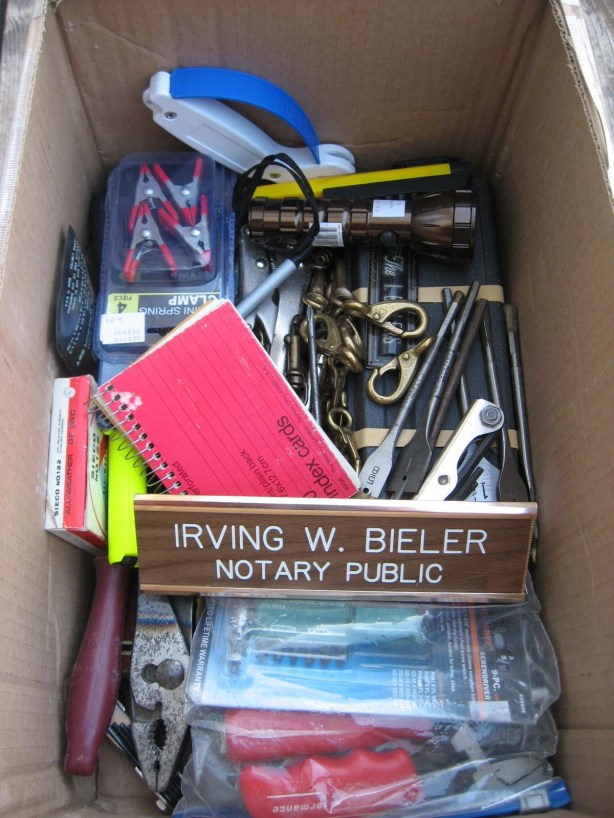
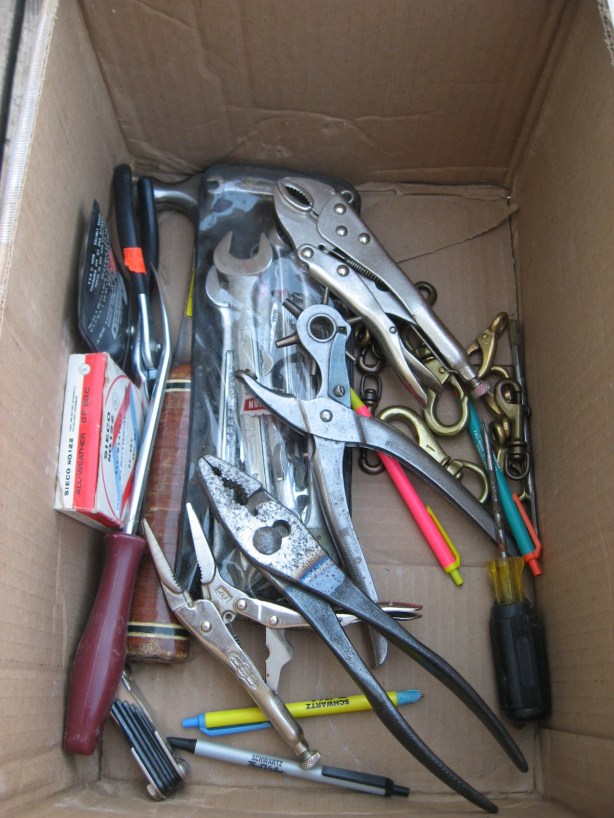
Ever since I left home, my father has been shipping me boxes of stuff. Sometimes he packs up pieces of our history. Sometimes he returns the book or the shirt or whatever it was I left behind on my last visit. Most times he ships the things he believes I can’t live without.

For example…

  • A glamour photo of Mom and Dad when they got engaged.
  • The menu from their wedding.
  • The license plate of the first car I drove.
  • The operating manual to our first power lawnmower.
  • The legs to the table Dad built when I was six to hold my electric trains, when I was thinking of adding a train room to my house. The legs were 14” tall. Dad had forgotten that I was no longer 6.
  • Army boots.
  • An anvil.
  • A brace-and-bit drill. What the Three Stooges couldn’t do with a brace-and-bit drill.
  • 40 hammers.
  • 100 bars of soap. I had just moved to Seattle and Dad was worried they didn’t sell soap.
  • 3,000 brass screws. That was two boxes.

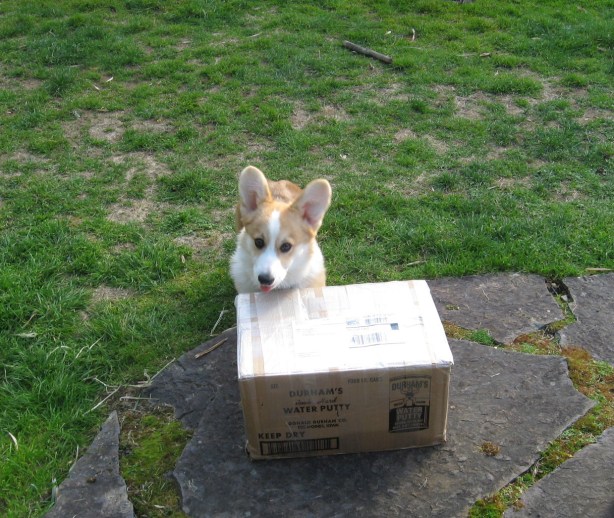
A new box arrived on Friday. Here it is with Mr. Lucky for scale:

box 3b

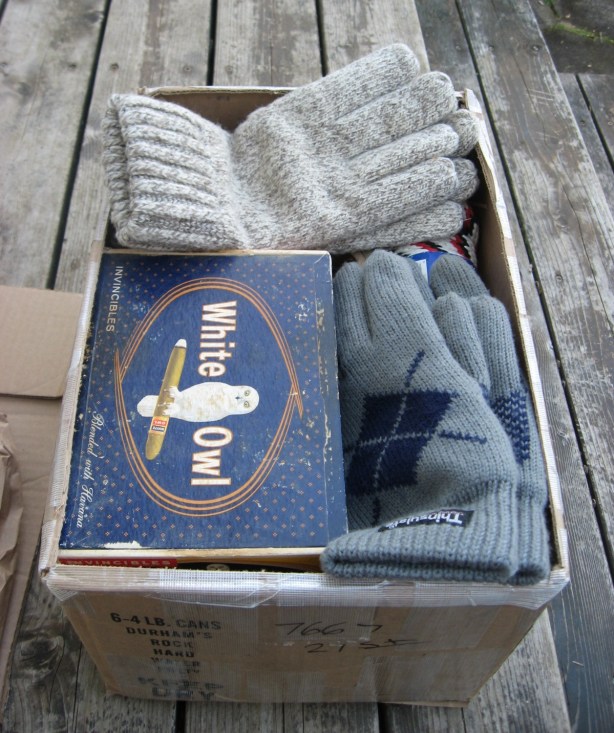
Dad armors these boxes until they can withstand truck and plane travel and, if necessary, a broadside from the U.S.S. Constitution. After ripsawing my way through the top, I saw this:

box 5

The gloves make good padding. They’ll find a home with the hundreds of other gloves Dad has used for padding.

Let’s start digging!

box 6

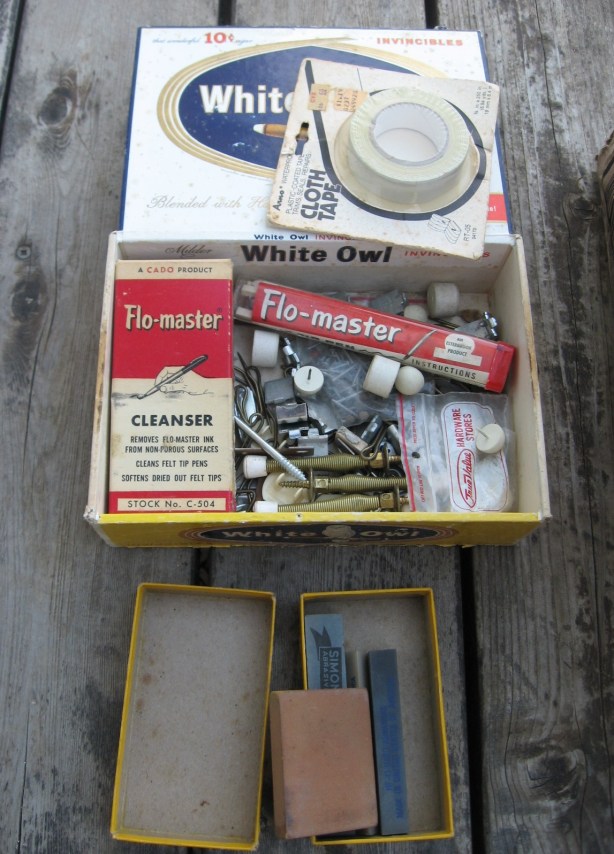
What’s in that cigar box, and the yellow box behind it?

box 7

An ancestor of the Flair pen, 39 brass drapery hooks, sharpening stones, and the kind of springy doorstop that kids of my generation loved to thwang against the wall with the toe of their sneakers. This time around, Dad must’ve been emptying the junk drawer he started filling in 1957.

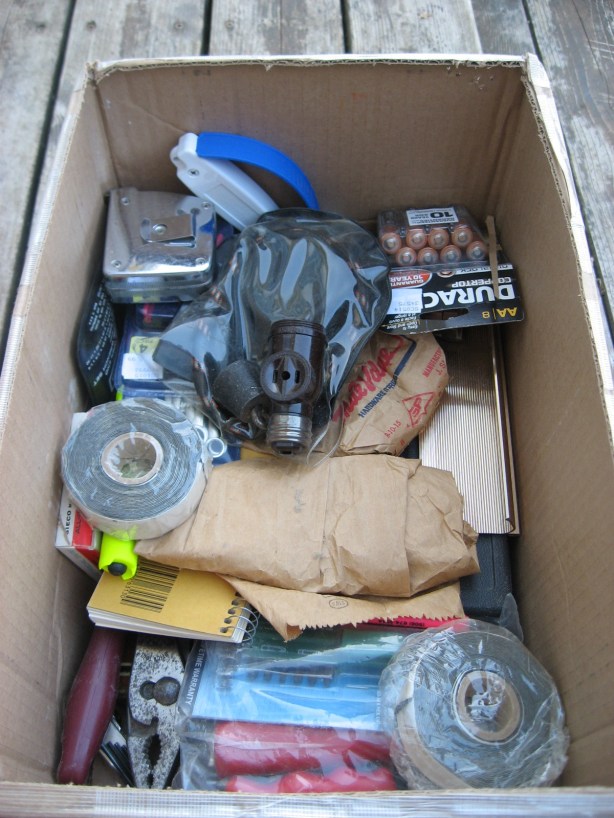
Back to the box. I’ll remove one layer at a time:

box 8

box 9

box 10

The gray boxes are sets of socket wrenches. Gotta have those. Wait, I already do!

box 12

box 13

box 14

These boxes are complicated – not because of the merchandise, but because of the emotions they represent. Or maybe these boxes are simple – they are solid love. I wrote this post and took these photos because Dad is a World War II veteran living in the 21st century and I won’t have him and Mom around forever. I once received these boxes several times each year. Now they’re uncommon, like birds that have changed their migration pattern. I’ve often felt inundated by junk, but for all the inconvenience, I’ll miss these boxes when I no longer find them waiting patiently for me on the front step.

What’s in the mail? Memories. A parent’s care. And flashlights.

Electric
The Cult
1987

When I was younger I wanted to find a band that rocked as hard as AC/DC but that didn’t view women as subhuman breeding stock. A band that was as heavy as Led Zeppelin minus all the mystical claptrap. I don’t know if this band has ever existed (I’m open to your recommendations), but I do know that there are albums that qualify. One is Nirvana’s Nevermind (1991). Another is my subject this evening.

Southern Death Cult was formed in 1981 by four boys from Yorkshire. By 2012, when they released their 40,000th comeback record, Choice of Weapon, 23 boys had worn the uniform. The only constants were Ian Astbury (vocals) and Billy Duffy (guitar). Ian and Billy were goths with a taste for metal and a fixation on North American Indians. Sure, why not.

Southern Death Cult gradually phased out the goth and the Indians and the Southern and the Death. (Why would you mess with a name as venomous as Southern Death Cult?) For their third album, they corralled a new producer, Rick Rubin, a man who eats transformation for breakfast, and with his help they broke the chains of gravity with their magnum opus, Electric.

What we have here are songs that embody the one thing we love about AC/DC – mindless butt-shaking – with the one thing we love about Led Zep – guitar solos that pull 4 or 5 G’s. There’s no moody-teenager philosophizing, no misogyny, no Middle Earth, and no intelligence. This album rocks like 12 Republican governors running for president inside a cement mixer.

Tracks 4 through 8, the heart of the order, hit harder than a brass knuckle barn dance. “Bad Fun” has so many layers, it’s as if somebody cloned every dork in Yes and suctioned them into a Yugo. The guitar solos – all of the guitar solos – are awesome because they all sound like metal guitar solo gibberish. Were The Cult subversive or satirical? There’s no way to tell. I don’t care. I love this shit.

An homage to “I Am the Walrus” or plain old drug abuse?
And yet Electric is also one of the funniest albums ever recorded. The lyrics have been brilliantly deconstructed and rebuilt, often with no translatable meaning, as in this unrhymed couplet from “Aphrodisiac Jacket” (a song that sounds like Cream has a brain tumor):

Sittin’ on a mountain looking at the sun
Plastic fantastic lobster telephone

In “Bad Fun,” a song that mixes atomic bombs, “fancy clothes,” and “ghetto stars” without telling you why, the boys break into a chorus about a woman alone with her personal assistant:

Spirit like a rumblin’ train
Spirit of the thunderin’ rain
Vibrations got you on the run
Electric child on bad fun

You can’t not laugh when Ian rolls his r’s or when they swing into their insightful commentary on intimate relationships, “Love Removal Machine,” a song my wife claims she has never heard and yet her life runs along just fine. You can’t not laugh when Billy lights this candle with another solo he checked out from the library, or when the band chants PEACE. DOG. PEACE. DOG. PEACE. DOG. on a song that’s called – let me see, what was it? I knew it a moment ago – yes, I have it: “Peace Dog.”

The only poor choice on this disc was covering “Born to Be Wild” at two-thirds the speed of Steppenwolf. If you’re headin’ down the highway and people on the sidewalk are passing you than you’re not born to be wild or even mischievous.

On The Cult’s previous release, Love (1985), you can hear the transition to a harder rock sound, but it was not until Electric that these ex-goths achieved nirvana. Oh right, “Nirvana” is a song on Love. “When the music is loud, we all get down,” Ian sings. Couldn’t have said it better myself.

Postscript courtesy of the concert listings at PortlandMercury.com:
AC/DC, Tuesday, Feb. 2, Tacoma Dome
“The band isn’t playing Portland tonight – apparently we’re not good enough – but it’s probably worth the drive to Tacoma. Because, you know, they might die soon.”


The naturalist Hal Borland wrote a memoir called The Dog Who Came to Stay. You can tell from the title how that story turned out. This story is not that story.

In September we promoted a promising new player to our family: a 10-week-old corgi. We named her Xena, Warrior Puppy.

debate prep
Xena listens to another Republican presidential debate.

Soon we were all in love, despite having to rush her outside in the middle of the night and the accidents on unlucky carpets. We were all planning to live happily ever after.

Right?

Long-term readers of this blog know I’m about to say Wrong!

We lived happily ever after for approximately two months while Xena grew from a 6-pound puff ball into an actual canine. Then she got scared. We don’t know what the trigger was, but I blame the folks on the next block who are addicted to inflatable Disney crap. One night right before Halloween, Xena and I encountered the huge gaseous Minions these style masters had staked to the grass (and the side of the house, and the roof). Xena immediately turned and rushed me homeward. I figured she had good taste.

Wrong!

Over the next three months, Xena conceived a theory of the world as being about as safe as the set of The Walking Dead. She became afraid of cars, trucks, bikes, scooters, and joggers. True to her name, she wanted to fight them. It took me an hour to negotiate a truce between her and our exercise cycle. Xena was suffering from what’s called “reactivity.” It’s uncommon. We were stuck with it.

We read the research. We hired experts. We tried various fixes. We despaired. We couldn’t walk Xena in our own neighborhood. On Tuesdays, when the Trucks of Terror came for our garbage and recycling, my wife and our dog had to be somewhere far away – one of Saturn’s moons, for example. We had to smuggle her into parks, waiting in the car until we had a clear run for the trees. It was like living in O. Henry’s “The Ransom of Red Chief,” where the desperate kidnappers pay the father to take his brat back.

Few things in life are as unsettling as a dog erupting two feet from your head at 4 in the morning because she wants to chase down and kill a freight train trying to sneak past her – a mile away. In all the years we’ve lived with corgis, only one ever reacted to a moving train, and that was because she’d spotted a man standing in the open door of a boxcar. Emma knew that was a safety violation.

No one here at the Bureau was thriving.

Special D finally called the breeder, who said she’d never had a litter like this and that two other people had already returned their pups. We said, we’re returning ours.

It was an emotional decision, made even more emotional by the lengthy drive to the mountain town Xena came from. Now we’d lost three dogs in three years, but this one was still alive. And ready to attack.

Xena was quiet most of the trip (we could only give her breaks in secluded areas off the highway), but when we got within 15 miles of her ancestral home, she started to bark. She knew where she was.

We arrived after dark. Xena almost flew out of the back of the car. I put her in the breeder’s arms. Xena wiggled with joy and licked the woman’s face – and then she turned and licked mine.

She’s saying goodbye, I thought, and she’s pierced my heart. No, of course not, I told myself; humans think that way, not dogs. We endow our dogs with human personalities. We speak for them. But we are not dogs and dogs are not us.

I realized that I couldn’t go through life thinking that I had failed this dog and yet she still had the decency to wish me well.

So I changed my thinking.

Xena is back at the breeder’s, with her mother and two of her siblings, in a rural area with little traffic. She’ll eventually go to a home with a lower threat level than our place. She’ll feel safe. She’ll thrive.

Xena wasn’t saying goodbye on that cold, disturbing night. She was saying thank you.

That was a month ago. Yesterday we brought home a new dog. We’ve named him Lucky. We hope this one will stay.


I can’t bid adieu to Scotland without bringing to your attention the Scotch influence on one of the world’s most popular games.

Not golf, Mr. Spock. Checkers.

The modern history of the game we North Americans call checkers began a thousand years ago on the Iberian Peninsula, where the Moors (the illegal immigrants of that era) and the Spanish (who wanted to build a wall and make the Moors pay for it) spent centuries fighting over which of them would one day oppress the Basques.

The Moors had brought with them a board game they called el-quirkat. The Spanish called it alquerque (pronounced like Albuquerque, minus the third and fourth letters). You played with a 12-man army and captured by jumping. The board was divided into 64 squares as plain as graph paper. The pieces sat on the intersections, not within the squares.

The Spanish passed alquerque to the French, who colored in half the squares and moved the pieces off the intersections. Now all they needed was a new name.

Back up a minute
When chess came to Europe from the Middle East, it had no queen. It had a counselor (in Persian, the fers) who moved one square at a time and captured by jumping. When the Europeans were handed checkers, they already had chess, and the checkers men moved like the fers, so they called checkers ferses. As soon as they did they agreed it was a dumb name.

Also, people were stealing ferses from chess sets and using them for the men in checkers. Nothing makes a chess player angrier than hunting around for a coin or a bobbin or a Monopoly token to stand in for a missing chess piece. That’s like using somebody’s sweater for second base.

Sometime in the 1300s or 1400s, the Europeans fired the counselor from chess and hired the queen – in French, the dame. The French extended this transformation to checkers. Now instead of 12 fers you had 12 queens. When a queen reached the last rank in this new form of checkers, she became a he – a king. He was then paid 25% more.

The French took one look at all those broads on the board and renamed the game dames. This name followed the game as it spread across Europe; in Turkey, for example, checkers is called dama.

The English say no to the European Union
The English refer to checkers as draughts, pronounced “drafts.” But in some rural parts of England, the name draughts took a long time to catch on. People in those areas called it checkers because of the checkered board. This includes the Pilgrims, who landed on Plymouth Rock carrying the Mayflower Compact and institutional racism. Oh, and a checkers set.

What about the Scots, then?
Hold your tartans, laddie, I’m getting there. The Scots got checkers not from their enemies, the English, but from their employers, the Dutch. Many Scotsmen served in Dutch armies in the 1600s. The Dutch called checkers damen. The kilted mercenaries who brought it home called it dams.

The first book written in English on checkers was published in 1756. Somebody smuggled a samizdat copy into Scotland, where it created a sensation (and deep-sixed the name “dams”). For the next hundred years, the Scots owned checkers, bitches. They were still producing world champions in the 1920s.

The Scots also named most of the opening systems. In chess, you have the Queen’s Gambit, the King’s Indian, and the Sicilian Defense. In checkers, there’s the Edinburgh, the Glasgow, and the Bonnie Dundee, as well as the Will-o-the-Wisp, the Laird & the Lady, and the Ayrshire Lassie.

Today, the ultimate checkers player is a computer from Canada, and the game may in fact have been solved. But you’ll never separate the Scotch from the checkers.

Thus ends my tour of all things Scottish. As my ancestor William Wallace cried in Braveheart, Alba gu bràth! (Gaelic for “It’s your turn. Would you move already?”)

Random Pick of the Day
Jimmy Witherspoon, The Concerts
1989
Combines Jimmy Witherspoon at the Monterey Jazz Festival (1960) and At the Renaissance with the Gerry Mulligan & Ben Webster Quintet (1959)

Two live sets from Checker Records artist Jimmy Witherspoon, though neither set was released on Checker and this comp appeared on yet another label. These records are a good look at genres of music (blues, R&B, jazz) that were fading from the pop mainstream.

On the first eight tracks, recorded in an outdoor space where it’s difficult to hear the crowd, the blues shouter holds your attention even as he holds back on the shouting. He delivers a slow “C.C. Rider” that makes you listen as if you’ve never heard this before.

Tracks 9-15 were recorded indoors, and we have the pleasure of hearing the man full-blast with some major-league jazzmen behind him. Witherspoon, having spent the evening singing about dicey women and trouble in general, introduces a special guest: “For the first time in her life, one of the greatest persons in my life is in here tonight to hear me sing. My mother. Let’s give her a big hand.” He then ignites a soulful version of “Ain’t Nobody’s Business.” Was he sending Mom a message or was it just next on the set list? Maybe it was the family theme song.

Pack Jimmy Witherspoon, The Concerts for a long car trip.


Weightlifting cover

Weightlifting
The Trashcan Sinatras
2004

In 1999, I edited a magazine for software company called Visio. One of my columnists was Dave, our Chief Technical Evangelist. Dave was a software maestro and the champion of all things Scottish. “Aye, Steve, it’s a hildy, wildy day, but I’ll wager there’ll be a glent o’ sunsheen yet,” he’d say before ducking into his office. It looked like he was refighting Culloden in there.

Dave kept trying to sneak his Broad Scots dialect into articles on such Scots-friendly topics as using Visio to automate Excel spreadsheets. One of his vocabulary words was “Slàinte!,” a traditional greeting that I believe means “Slammin’!” This behavior might’ve fooled another editor, but not me, because guess what? I’m a Scot.

Not everyone knows this. For many years I didn’t know this. Then one day when I was skylarking in Edinburgh, I happened to pass a souvenir shop. The employee stationed outside asked me, “Sir! What’s yer family name?” When I told him he cried, “Lad, if yer name is Bieler, that means yer an Aberdeen!”

I’m a smart tourist, and I realize I could’ve told him I was Ho Chi Minh or Salvatore Bazooka and he would’ve told me I was a Campbell or a MacDougall, but his Star Fleet engineer’s accent was convincing and anyway my wife and I had recently seen an awesome staging of Macbeth. Before you could say “Something wicked this way comes” I was proudly wrapped in a scarf woven in my Aberdeen clan colors. (But I said no to the kilt, the vest, the big old shorts, and the condoms.)

Until it’s time to go a-roamin’ in the gloamin’, then, I’ll keep enjoying my Scottish music an a’that. I’ve already written about Dire Straits, Donovan, and Simple Minds. There are plenty more to go, from Average White Band to The Waterboys. (Bay City Rollers? That’s takin’ the low road to Loch Lomond, laddie.) Before I get to today’s topic, here are a few of the early milestones, or perhaps roadblocks, of Scottish popular music.

Most scholars agree, especially after enough blended malt whisky, that the Scots came to world attention in 1967 with Lulu’s super explosive smash hit explosion “To Sir with Love.” I was moved by “To Sir” when I was 12, but today the only thing that catches my jaded attention is that it was produced by John Paul Jones. A year later, Jones became the bass player for Led Zeppelin.

In 1971, Middle of the Road took revenge for the Highland Clearances when they released “Chirpy Chirpy Cheep Cheep.” Yes, all those sword-swinging Scotsmen fighting in the mud on Outlander evolved into “Where’s your momma gone, little baby bird?” Though I find this song about as appealing as someone paving my breakfast with a layer of haggis, I will always give this band some slack because their singer, Susan Carr, may have had the best legs in Scotland.

Maggie Bell is a Scottish soul singer who could mix shades of Tina Turner, Bonnie Raitt, Marianne Faithfull, and Joe Cocker into one groovy cocktail. Sadly, her material was never as good as her voice. Her debut album, Queen of the Night (1974), gave her her sole hit in the USA: a calypso-inspired version of Eric Clapton’s “After Midnight.” I don’t know how this happened because this is the one song on the disc that isn’t a vocal showcase. She deserved better. I’d yell my Clan Aberdeen battle cry here, but I took an oath to use it solely against our blood enemies, Clan Coldplay.

Bagpipes! You thought I’d forget. I once attended a bagpipe recital. Every bagpiper onstage had won at least 10 awards (every FN one of which was announced), though no two bagpipers seemed to have attended the same competition. From this I learned that bagpipers, journalists, and third-graders all receive awards for everything they do.

Toss that funky caber, white boy
Now we come to The Trashcan Sinatras, Glaswegians who have the most stupendous band name in the history of Scotland. I just scoured the Wikipedia page that lists every Scottish band since Mary, Queen of Scots (rhythm guitar and mouth harp) and the Trashies’ only competition comes from The Blow Monkeys, Teenage Fanclub, and Shitdisco.

The lassie in the office next to mine is a highly placed officer in the international Trashcan cult. To preserve her identity I’ll call her Lorna. “We Trashcan Sinatras listeners take our affiliations very seriously,” Lorna wrote in an email. “Are you one of us?”

It’s a shame for a good Scotsman to admit it, but I’m not up on me Trashcans. Lorna recommended that I begin with the band’s fourth album, Weightlifting. This was their comeback; they recorded it after a gap of eight years. Weightlifting is a sly, melodic companion that rocks when it feels like it (“Welcome Back”) but mostly chills.

“Not everyone can handle their intricate, ethereal smoothness,” Lorna informed me, and she’s right. Weighlifting is too laid-back for me, though I did find the title track interesting. Plus the album cover is actually worth framing. If you like The BoDeans or (in their lighter moments) Big Head Todd & The Monsters, I think you’ll enjoy The Trashcan Sinatras.

Goodbye just now, honest men and bonnie lasses, and one day we’ll take up another aspect of my ethnic heritage: Norwegian death metal. Until then…Slàinte!

Bonus: Here’s Middle of the Road, 30 years later.