Archive for the ‘Writing’ Category

Natl Poetry Month 1

“There is the view that poetry should improve your life. I think people confuse it with the Salvation Army.” – John Ashberry

We enjoy poetry here at the Bureau, but most of the time we never get around to reading any. That’s a shame in a language that includes Robert Frost and the birch trees he observed bent by the snow,

So low for long, they never right themselves:
You may see their trunks arching in the woods
Years afterwards, trailing their leaves on the ground
Like girls on hands and knees that throw their hair
Before them over their heads to dry in the sun.

It’s not National Poetry Month (that was in April), but it is July and the outdoors are calling me. This makes me think of poetry about nature that’s really about people but then again maybe it’s about nature.

It’s impossible not to read the entire poem after archy the cockroach gives us this opening in “the lesson of the moth”:

i was talking to a moth
the other evening
he was trying to break into
an electric light bulb
and fry himself on the wires

William Stafford tells the story of a pile of rocks in “Silver Star.” Here’s how it begins:

To be a mountain you have to climb alone
and accept all that rain and snow. You have to look
far away when evening comes. If a forest
grows, you care; you stand there leaning against
the wind, waiting for someone with faith enough
to ask you to move. Great stones will tumble
against each other and gouge your sides. A storm
will live somewhere in your canyons hoarding its lightning.

But the poem I want to relate this evening is this one, by Paul Zimmer, called “Old Woodpecker.” It’s copyright 1989 by Mr. Zimmer and here it is in its entirety:

In the end his tiny eyes won’t focus.
Punchy, his snap gone, he spends his
Time banging on gutters and drainpipes.
He begins to slurr and churrrr,
His breath descending in a rattle,
He tells endless stories of old trees
Taken, but he has absorbed one too many
Hardwoods to his noggin, his brain is
Pudding. For the rest of his time
He will undulate around, patronized,
Spunky but sweet, remembering only
Nests of teeming carpenter ants,
Consenting grubs under flaps of bark,
The days when he was a contender
Amongst the great woods of his life.

Yes, I did write today here in the Write-a-thon, but no, I am not converting my book to any form of free or rhymed verse. I just felt like reading some poetry, and I wasn’t about to torment you with my own.

Anna Glassman 1 Key West 1960
Anna Bieler Glassman on her honeymoon in Key West, Florida, 1960

My Aunt Anna died today. She was born in 1919, the first of eight children, including my Dad. I think of Dad and his siblings as the Pioneer Generation – the first Bielers born in the United States.

Anna was a few weeks short of 95. She’d lived most of her life in Manhattan and loved every minute of it.

Anna was probably my biggest fan. Her late husband, Jerry, had been a playwright, and she was thrilled that I was a writer, too. Twice when I was in high school I spent a summer week with them in their book-packed apartment near Columbia University. Anna took me to bookstores, museums, and to the top of the Empire State Building. Jerry, who had been wrestling with writer’s block for years, talked to me about writers and writing. It was heady stuff for a kid from a nowhere town in rural Massachusetts.

For years, Anna asked me if I was writing and told me how she hoped to see my name on a book someday. When I went to New York in 2006 to give the toast at my cousin Philip’s wedding, she asked me again. I told her I had an idea for a novel and that this time it didn’t seem like the kind of idea that rides back into the ocean on the next tide. She said, “I want to live long enough to read it.” She didn’t, for which I am sorry.

The best I can do now is finish what I’ve started and write something good. “What I want is for a work of art to move me on as many levels as possible – I want it to split my sides, blow my mind, and break my heart.” (James Hannaham)

I had 16 aunts and uncles in 1967 when the last of them married, and I’m happy to say I knew them all. Here it is almost half a century later and I still have nine. How lucky is that?

Kind of a mixed up writing day here in the Write-a-thon, but as mixed up as it was it still added up to an hour.

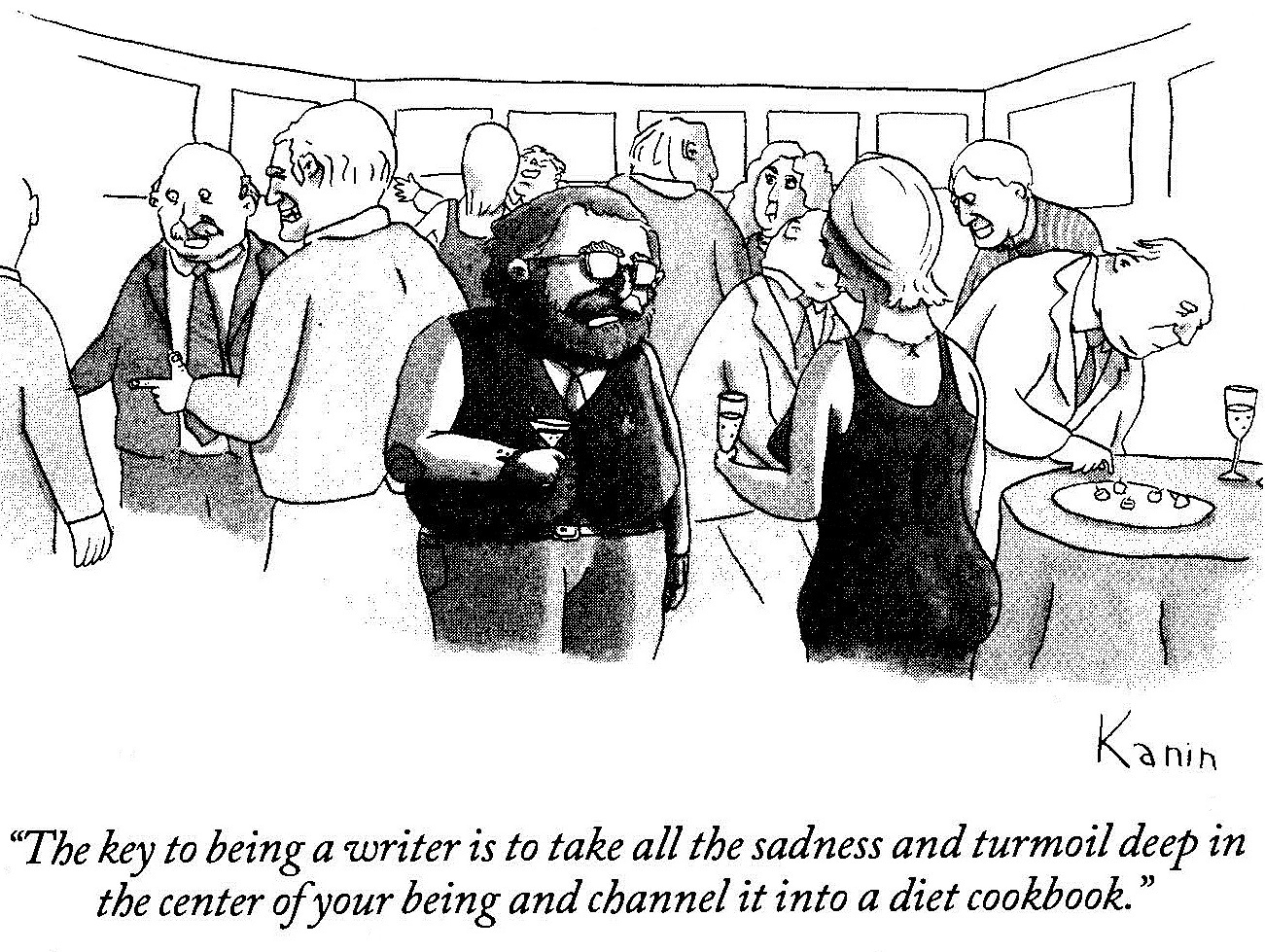
Diet cookbook 1

When I was in junior high, I started reading The Writer, which surely must stand as one of the worst-designed magazines of its day. It was filled with advice on writing, mostly, as I recall, from second-string novelists and science fiction and mystery writers. There were even a number of writers who made some kind of living from writing Westerns, which were still kicking around. Point of view was a big topic. So was first person vs. third person. These topics will never go out of style.

For a while the pages were very thick. I used some of them for backing or shims when I built models out of balsa.

The editor, A.S. Burack, was nearing the end of 40 years at the top of this heap. He began editing The Writer during the Depression and finished in the disco era. He wasn’t the first Writer editor to span generations – co-founder William H. Hills started out with the Robber Barons and finished in the Jazz Age.

The Writer is still being published, and in this century has become attractive and even innovative. I look at it sometimes online. But I miss Lesley Conger.

Lesley Conger (real name Shirley Suttles) wrote the “Off the Cuff” column from 1965 to 1980. In her charming, everyday, no-nonsense, and yet off-kilter style she spent 15 years telling us what the life of a working writer was like. Her columns were collected in To Writers, With Love, a hopelessly outdated book about postage, her passion for good typing bond, and miniscule pay rates. OK, that last part isn’t outdated.

My favorite episode in To Writers, With Love was the time Conger and her husband, a professor, tried to turn their bedroom into an office and ended up hauling in there almost every stick of furniture they owned. Though I also remember how, at the height of Bobby Fischer mania, she used his book Bobby Fischer Teaches Chess as an example of why writing can’t be taught but how she wished it could be.

I love this book, though I’m positive that nostalgia helps. Conger, according to her 2010 obituary, published stories in magazines “from Cosmopolitan to Good Housekeeping to Playboy.” Her book will not help you do the same. It won’t teach you how to write. A lot of it is complaints! But reading her columns when I was 13 gave me an idea of what went on in a writer’s head. I couldn’t get that anywhere else. In skimming To Writers, With Love this evening, I was struck by all the useless information, and yet it still fired my imagination. Maybe it’s the equivalent of meatloaf and mashed potatoes – comfort reading.

The one quote Lesley Conger is known for is her advice to beginning writers: “You don’t need to know very much to start with, if you know the way to the public library.” Outdated, sure. But loving.

Wrote today for the 16th day!


On Company Time 1

I wrote 700 words this week. That is, I kept 700 words. I wrote many more than that. “Sit down and put down everything that comes into your head and then you’re a writer,” Colette said. “But an author is one who can judge his own stuff’s worth, without pity, and destroy most of it.”

Good call, Colette, but I have to pick up the pace or I’ll be working on this book on my deathbed. It’s time to embrace the advice of William Stafford: “Lower your standards and keep on writing.” I’m going to try that this week, as I have something coming up that I will reveal either late Friday night or early Saturday morning. Let’s see if I can work myself into a sprint, or at least a forthright trot.

“Be bold, thrust forward, and have the courage to fail. After all, it’s only writing. Nobody is going to die for our mistakes or even lose their teeth.” (Garrison Keillor)

Sunday Bargain Basement Sunday
Today I stepped out of the sunshine to attend the worst estate sale since the invention of capitalism. It was held in what I guess was a former fraternity house, a three-level shitbox that was a mouse’s maze filled with mattresses, mattress boxes, and wooden bureaus. It looked like an alternate-universe version of Sleep Country USA where Spock wears a beard, Uhura wears a knife, and the furniture is covered with generations of condensation rings from red plastic party cups.

Cool jazz all week
No more music reviews for a while. I gotta concentrate, and not on Queens of the Stone Age, who didn’t do much for me today. I will say that I also listened to Crosby, Stills, Nash & Young’s Four Way Street. Some of those songs ascend to a higher plane. But there’s something to be said for Crosby, Stills & Nash, which was recorded before they knew they were superstars.

I wonder why only Neil Young was able to change with the times and remain in the forefront of rock? David, Stephen, and Graham, as talented as they are, haven’t moved a millimeter past 1971. Though maybe that’s why they remain beloved while Neil seems unpredictable and not embraceable.

Consumer alert: There’s a string quartet and a bluegrass tribute to Four Way Street.

Box score
– I’ve written 15 days out of 15
– 19.5 total hours
– Current word total: 20,300
– Here’s the Clarion West Write-a-thon
– Here’s my first post on the Write-a-thon
My video has stalled at 148 views. Going viral is harder than it looks!

My sponsors (all hail):
– Karen G. Anderson
– Mitch Katz
– Laurel Sercombe

As always, thanks for following along, even though you won’t win a 20-volume set of the Encyclopedia International, a case of Turtle Wax, or a year’s supply of Rice-A-Roni, the San Francisco Treat. You don’t even get a lousy copy of our home game!


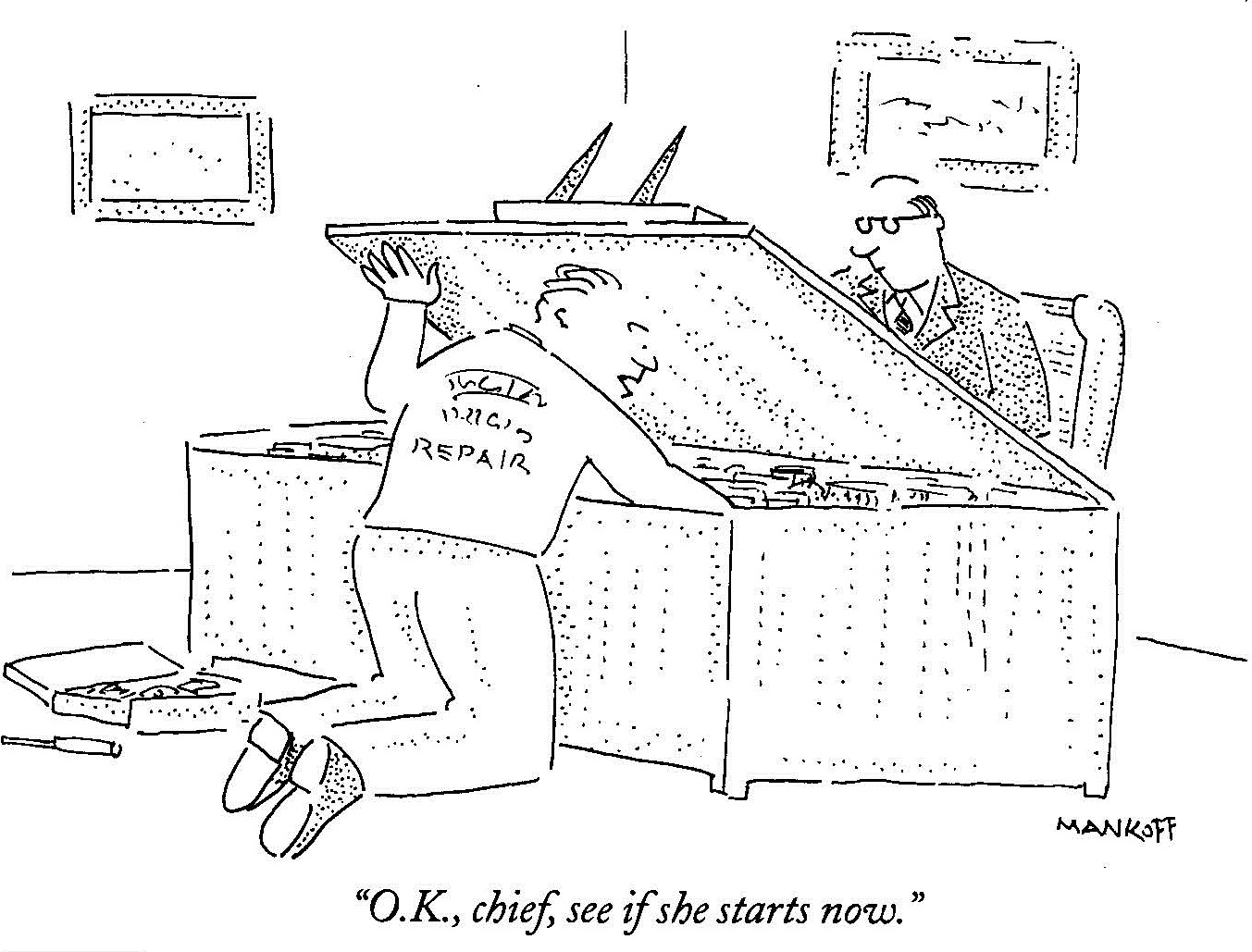
OK chief

I get a progress report each week on the current Clarion West workshop and this week’s instructor:

“It’s week two of the writing part of the Write-a-thon for 345 writers all over the world and week two of the six-week workshop for 18 writers in Seattle. This week, Neil Gaiman went flat out, energized the students, read them bedtime stories, and took them to the movies. We all hope he gets a nap soon.”

Movies? Bedtime stories? I don’t remember any of that at my Clarion! At my Clarion, the big event during week two was they finally gave us pencils and paper. Until then we had to open a vein and use our fingers to write on the wall.

Would you know we’re riding on the Marrakesh Express?
Oh did I get a great book on my birthday: Slow Train to Yesterday by Archie Robertson (1945). What I love about this book is not the stuff about trains but about the U.S. home front during World War II. After Pearl Harbor, gasoline was rationed, and people had to turn to trains for transportation. Because it was often impossible to get a ticket on the mainline passenger trains, which were packed with soldiers, civilians turned to the wheezy old short-line railroads.

Our view of the past is monolithic. Most of us would probably assume that everyone in 1942 was familiar with train travel. Not so – Robertson, in his travels, keeps finding fellow passengers who had never been on a train. They were only there because they couldn’t gas up their cars.

Robertson is not the greatest writer around, but he fires off the occasional le mot juste. He observes a dinky old locomotive, at the appointed hour, “shaking itself like a dog coming out of the rain” and rolling down the track. He describes a 30-mile rural railroad as “a backwoodsman’s train with less polish and more spit.”

Helplessly hoping
This afternoon I went back and fattened up some existing chapters. That was satisfying but it’s not pushing me forward. I sense I’m hesitating because I have a difficult scene coming at me. I’m stalling for time, but frankly, I don’t have that kind of time. I’ll try to floor it tomorrow.

Random Pick of the Day
Crosby, Stills & Nash, Crosby, Stills & Nash (1969)
In junior high I loved this album so much that I dressed every day like the effortlessly cool, laid-back boys on the cover. Listening to it now, I became impatient over the course of the first three tracks. In fact, I wanted to run those boys over with a cement mixer. But I fell in love again with the fourth track, “You Don’t Have to Cry,” and believe me, I am not the kind of listener who rolls over just because you sing like angels.

“Pre-Road Downs” is so good, it foreshadows Paul Simon’s solo career. By the time I got to “Wooden Ships” I was impressed by the melodic hard rock and suddenly understood a) why Jimi Hendrix had so much respect for this band, and b) the incredible musicianship on display here. “Long Time Gone” and the closer, “49 Bye-Byes,” sealed the deal for me.

It’s difficult to listen to famous albums you’ve heard a billion times and get anything new out of them. You have to peel back the layers of history and nostalgia and the discarded skins of your former self. Some of the songs in this lineup make me cringe – for example, the soporific “Lady of the Island” (“The brownness of your body in the fire glow/Except the places where the sun refused to go”). But this is, after all, an aural snapshot of its time. I wouldn’t want to read a transcript of my dialog from any day in junior high.

Crosby, Stills & Nash may be the first mature rock album. Whether that’s good or bad is beyond me.