Archive for the ‘music’ Category

Ashford and Simpson discography

The bottom line:
I’m stretching the rules of the forgotten bands game with this choice, because songwriters Nickolas Ashford and Valerie Simpson are remembered – but only by writers and music nerds.

Songwriters don’t become famous unless they become famous performers. Just ask Bernie Taupin, the lyricist behind Elton John. Neil Diamond, Willie Nelson, and Carole King (but not her former husband and writing partner, Gerry Goffin) began as writers but broke as performers.

Their story:
Nickolas Ashford and Valerie Simpson met in a gospel choir and were songwriting partners and performers for 50 years until Ashford’s death in 2011.

Marvin Gaye and Tammi Terrell sang “Ain’t No Mountain High Enough,” “Ain’t Nothing Like the Real Thing,” and “You’re All I Need to Get By.” Ashford and Simpson wrote all three.

“Let’s Go Get Stoned” and “I Don’t Need No Doctor” were two signature tunes for Ray Charles. He can thank Ashford and Simpson.

Ten of the 11 songs on Diana Ross, the first Diana Ross solo record, were written by Ashford and Simpson.

“I’m Every Woman,” Chaka Kahn’s first hit after she left Rufus? Let me see, I knew it a second ago…oh yes, Ashford and Simpson.

“Stairway to Heaven”? No, they didn’t write that one, but if you’ve been following the legal battle over “Stairway” it could be that Led Zeppelin didn’t write it either.

Ashford and Simpson recorded a long line of their own albums. I’ve listened to them all, though after awhile I only gave each record three tracks before moving on. Their work is good-natured, and our heroes sing like angels (Simpson’s range is astronomical, and Ashford knows that a good husband always backs up his wife), but the music is mostly waterlogged disco.

All these albums with the couple’s happy photos on the covers – is there a meaning here? Yes there is, and I didn’t have to work too hard to find it.

The music of Ashford and Simpson, the music they wrote for themselves, stands for partnership, commitment, and, as another writer who made his name as a performer, Lionel Ritchie, once wrote for Diana, everlasting love.

Moment of glory:
Writing for Gaye, Charles, Ross, and Kahn should be glorious enough, but I’ll pick sharing their 1996 release, Been Found, with poet Maya Angelou.

The one album to own:
Diana Ross. (The first one, with “Remember Me” and her cover of “Ain’t No Mountain High Enough.” Her record company named three albums Diana Ross.) Want an Ashford and Simpson just for Ashford and Simpson? I’d advise against it, but you might try their last record, The Real Thing (2009), which was recorded live in a small club.

Tomorrow, forgotten bands continues with a band that intersected with my personal universe.

Last train to Torksville

Posted: February 21, 2019 in music
Tags: , , ,

I’m back from my away mission. It wasn’t the away mission I would prefer to go away for. Some guys go to New York, London, Paris, Munich. I go to Fall River, San Jose, and Merced. Merced. Fall River without the glitter.

If I owe you an email, I’ll reply after I finish this post.

If I owe you a letter, I’ll write one at the next monthly meeting of the typewriter club. Yes there is a typewriter club, and yes I go to their meetings. So long as those folks own typewriters, I don’t have to.

If I owe you a sext – no I don’t, I sent it from the airport!

Our series on forgotten bands continues tomorrow. See, I didn’t forget. But I am going to condense the nonsense, because I have other stuff to do and I’ve been having second thoughts about resurrecting some of these people.

RIP Peter Tork.

But the porpoise is waiting
Good-bye, good-bye
Good-bye, good-bye, good-bye

Surprise: “The Porpoise Song,” the psychedelic valentine from Head, a song that was written by Gerry Goffin and Carole King, is a favorite of headbangers. Middle-aged doom-dwellers Trouble perform one of the better covers. Give it a chance – there’s some awesome shredding at the 2:45 mark. Good-bye, good-bye, good-bye, Peter.

Shake Some Action

Bottom line:
Five boys from San Francisco who formed a hard-rock outfit in 1965, made three records (Supersnazz, Teenage Head, and Flamingo) that nobody listened to, then switched in 1976 to power pop and made twice as many records that nobody listened to.

Flamin’ is sometimes spelled without the apostrophe.

If you combine MC5, Steppenwolf, and The Stooges as played by The Rolling Stones and force Creedence and Grand Funk Railroad to get married, you’re somewhere near the original incarnation of The Flamin’ Groovies.

If you combine Cheap Trick, The Knack, The Romantics and many forgotten groupings of young white guys in skinny black ties (including Seattle favorites The Allies and The Rangehoods), then add some Byrds-style guitar, you’re talking about new-formula Groovies.

No hits. Never came close.

Vital personnel:
Roy Loney, singer, songwriter, guitarist until 1971, when he began his solo career, recording rockabilly records and working in a record store; Cyril Jordan, songwriter and guitarist forever.

Moment of glory:
Cyril Jordan: Releasing Fantastic Plastic, a well-above-average album of mostly new material in 2013, almost 50 years after the Groovies first got together, including a dynamite cover of The Beau Brummels’ “Don’t Talk to Strangers.”

Roy Loney: Everywhere this man plays, the local music critics rave about him.

About that name:
It’s the perfect name for a band that formed in 1965! Not to be confused with The Flaming Lips or The Groovie Ghoulies.

Their story:
Some guys have a string of ponies. The Flamin’ Groovies had a string of undercapitalized record labels. These are the kinds of places that can’t get their records into the hands of djs, that can’t get cash into the hands of djs, that will rush the band outside on a cloudy day and snap a photo in the parking lot to get something to the printer before the deadline for the album cover.

(The latter is my interpretation of what happened to the cover of Shake Some Action. If there really was a professional photographer involved with this crud, he should’ve been rewound and overexposed.)

The one album to own:
Flamingo, from the dawn of the 1970s. Some of this stuff is forgettable, but some of it rocks hard enough to shake the marmots off Mt. Rainier. (For example, “Road House,” which was a headbanger before we had headbangers.)

The essential track that’s not on this disc is “Shake Some Action,” a power pop anthem and the only Flamin’ Groovies song that ever got any airplay, though only on college radio. R.E.M. used college radio as a launching pad, but for most acts, college radio is not a transit station, it’s the junkyard.

I like junk, and I like The Flamin’ Groovies.

(Editor’s note: Our totally unbiased look at forgotten bands will continue in a week after Run-DMSteve returns from his tour of the fabled cities of the East, including Fall River, the Gateway to Taunton.)

The Byrds Gene Clark far right

Bottom line:
Our series on forgotten bands continues with folk- and country-rock pioneer Gene Clark, who wrote the best original songs on The Byrds’ first two albums, Mr. Tambourine Man and Turn! Turn! Turn! Exhibit A: “I’ll Feel a Whole Lot Better.” (On Fifth Dimension, he co-wrote “Eight Miles High.”) Clark went into country-rock full-time after leaving The Byrds in 1966, with excursions into roots rock, acoustic folk, romantic duets, and dense, prog-adjacent music.

The mystery to me is why this man didn’t ascend into Crosby, Stills & Nash with his Byrds buddy David Crosby or even in place of Crosby. Clark sang beautifully, though not as beautifully as Crosby, who may have been a UFO alien. Clark was a weak guitar player in his early years, and he would have had a problem keeping up with Stephen Stills and that other fella they hired, Neil somebody. But Crosby wasn’t exactly Jimi Hendrix or even Ron Elliott from The Beau Brummels. Clark was by far the more talented composer, plus he could take or leave hippies; Crosby couldn’t get enough of them.

Moment of glory:
Being a Byrd. That should be enough for most people. That’s him on the far right of one of the most famous album covers of the 1960s.

His story:
I’m going to keep this short because Clark, while prolific on his own, never got anywhere commercially, and I suspect that embittered him and led to his death at 47 from drinking. He reminds me of another unlucky natural, his contemporary Gram Parsons, who died under that Joshua tree so that U2 might live.

Speaking as someone who is talented but not talented enough, Clark’s story makes me uneasy. Good thing I keep my drinking (Manischewitz) under control (as in, only at Dad’s house*).

* Run-DMIrving once poured two colors of Manischewitz into one bottle because he was tired of two half-full bottles of the stuff taking up so much room in the fridge three months after he bought them for Passover.

The one album to own:
You already own them: Mr. Tambourine Man and Turn! Turn! Turn! His solo work is interesting one track, not so interesting the next, but if you prefer country, try Gene Clark with the Gosdin Brothers (“So You Say You Lost Your Baby”). If you prefer artsy rock, No Other (the title track). Something more Byrds-like? FireByrd (his joyful cover of Gordon Lightfoot’s “If You Could Read My Mind”). Frankly, you could sample the first three tracks on any Gene Clark album and probably hit something you like.

He was a complicated man. I wonder if anyone understood him.

That’s it for the sad forgotten bands. From here on it’s the upbeat, dynamic, eccentric, under-the-radar, gotta-dance, women-are-doing-it-for-themselves (and, in one case, deservedly forgotten) forgotten bands.


Introducing the Beau Brummels cropped

Bottom line:
Five guys from the folk-rock scene in San Francisco who developed a taste for country. Three Top 40 hits, including one in the Top 10 (“Just a Little”), and two more that broke the Top 100. How can a band that placed five songs in the Top 100 be forgotten? The answer is, they’re not forgotten, they’ve been immobilized in our minds, encased in one song: “Laugh, Laugh.”

Vital personnel:
Sid Valentino, lead vocals; Ron Elliott, guitar and main songwriter.

Moment of glory:
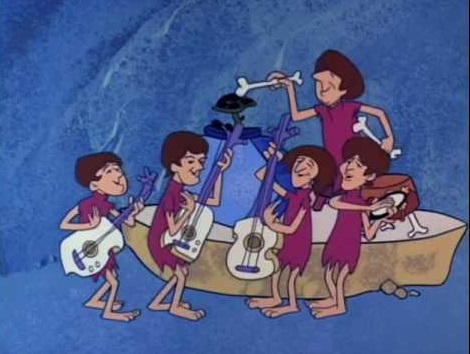
Thirty years before Smashing Pumpkins guest-starred on The Simpsons, The Beau Brummels guest-starred on The Flintstones.


Beau Brummelstones

About that name:
Why would five young Americans name themselves after an English fop who loved to play dress-up? The Brummels claimed they liked it, the way Ringo liked it when they painted him red again in Help. Cynics assumed that the boys chose the name to confuse shoppers with the English association and because record shops would file them immediately after The Beatles. All I know is, there’s no point in reopening an old family argument unless you’re one of my relatives.

Their story:
When Introducing the Beau Brumels debuted in April 1965, this band was the hottest band in the United States that was from the United States. For two months they stood alone against a horde of Beatles, Stones, Animals, Hermits, Hollies, Clarks, Playboys, and Zombies. The album was inconsistent, but with moments of excellence and an air of maturity not often found in records of that era.

Introducing the Beau Brummels (produced by Sylvester Stewart, who became Sly Stone the following year) gave us two hits: “Laugh, Laugh,” their ticket to Golden Oldies immortality, and the somber “Just a Little.” The guitar riff in “Just a Little” was ripped off from Link Wray’s “Rumble”; it serves well in this new setting.

The majority of the Brummels’ work is somber, even “Laugh, Laugh,” which is about being dumped. The critic Justin Farrar wrote of them, “The one quality that stands out when digging this stuff is just how sad and weathered the Brummels sounded for such a young band.”

The Brummels’ luck ran out in June 1965 when they collided with the debut from another folk-rock quintet, The Byrds’ Mr. Tambourine Man. It’s difficult to compete with a record that will – even cynics agree – live forever. Each band released another album before the year finished, but by then it was obvious that the Brummels were finished as well. They wrote more original material than The Byrds, but The Byrds played better, sang better, and had a flood of catchy ideas in their interpretations. Also, Roger McGuin, David Crosby, and Gene Clark (I’ll return to him) were soon writing better, too.

The rest of their story sounds like a fairy tale without the witch or the wolf.

The five little Brummels were no longer a force in pop music. Ron Elliott suffered complications from diabetes; he could record but he could no longer tour. One of the Brummels left the band, to play somewhere else or possibly from despair. For their third outing, in 1966, the four little Brummels landed at a much better record company, which was good, but the new company made them do covers like The Byrds, which turned out to be bad.

Then in 1967 the government drafted one of the four little Brummels for the army. The three little Brummels tried their luck with Triangle, an album of psychedelia, which was of the approximate quality as The Zombies’ attempt at psychedelia, Odyssey & Oracle, by which I mean it substantially sucked.

Then in 1968 the government drafted one of the three little Brummels for the army. Why did Lyndon Johnson hate our freedoms? The two little Brummels regrouped in Nashville, where they recorded a country-rock album in a barn owned by a man named Bradley. They called this album Bradley’s Barn. It was only the second country-rock album ever recorded (this time The Byrds beat them by two months, with Sweetheart of the Rodeo). I like this record despite the fact that “country” is one of the words in “country-rock.” Sadly, nobody at the time noticed it.

There are more ignored albums in their catalog, but enough is enough.

The one album to own:
The Beau Brummels, Vol. 2. It doesn’t have “Laugh, Laugh” and “Just a Little,” but it’s the strongest overall and it includes “Don’t Talk to Strangers” (their attempt at beating The Byrds at their own game), “Can It Be” (the best Everly Brothers song not penned and performed by an Everly), and the endearingly somber “You Tell Me Why” and “Sad Little Girl.”

Though The Beau Brummels, Vol. 2 proves that they were not one of the best bands of the 1960s, it does prove they were the best forgotten band of the 1960s.