Archive for the ‘Record reviews’ Category

By this point of my life, I expected to be famous, with a house shaped like a rook, five ex-wives, an agent who bathes her StairMastered curves in champagne, and an attorney named Bernie. I’ve fallen short of these goals, but I remain undaunted. Certain people I am married to remain skeptical.

Meanwhile, I’ve taken a lot of notes on life here in obscurity. Most of us puny humans live here. Ninety percent of all writers, for example. When I read Robert Calder’s Willie: The Life of W. Somerset Maugham, I realized that not only is Maugham (author of The Razor’s Edge, Of Human Bondage, and The Moon and Sixpence) disappearing from our consciousness, so are almost all of the writers he entertained around his dining-room table in the middle of the century. I wrote in this blog,Authors of 20, 40, even 60 books regularly enter these pages – names that have left barely a ripple in the fabric of space-time.”

Most jazz musicians are born in obscurity and stay that way. Louis Armstrong, Count Basie, Dave Brubeck, John Coltrane, Miles Davis, Duke Ellington, Ella Fitzgerald, Wynton Marsalis, and the horror that is Kenny G are known outside the jazz ghetto, but the list thins out fast after them.

On that happy note….It’s time to look at worthy bands (and artists) that have silently slid beneath the waves.

Not bands with cult followings, such as The Velvet Underground, Big Star, and Hüsker Dü. Not one-hit wonders that inflicted “Kung Fu Fighting,” “99 Luftballons,” or “Because I Got High” on us before being deported to some shithole country. No, I’m talking about bands that, for one reason or another, deserved better than the limbo in which they will probably forever reside.

Here’s my list – you probably have your own – with their approximate heyday:

1960s-70s:
The Beau Brummels
Gene Clark
Nickolas Ashford and Valerie Simpson

1970s:
The Flamin’ Groovies
The Beat

1980s:
The Call
Fiction Factory
Fischers-Z
Bonnie Hayes & The Wild Combo

1990s:
Diesel Park West

Some of these acts had hits. Most never rose above a few weeks of spins on college radio. One is no good. But they all have a story, at least to me, which I’ll tell as best I can over the next few days.

Random Pick of the Day
Art Blakey Quartet, A Jazz Message (1963)

Another jazz masterpiece from the year that ended with The Beatles on Ed Sullivan. One of the amazing things about this platter is that drummer Art Blakey, tenor and alto saxophonist Sonny Stitt, pianist McCoy Tyner, and bassist Art Davis were together for just one day, July 16, 1963.

The veterans, Blakey and Stitt, had last played together in 1950. The kids, Tyner and Davis, had barely started playing. On July 17, they went back to their own lives: Blakey to his leadership role in The Jazz Messengers, Stitt to one of the most prolific careers in jazz, Davis to his work with John Coltrane, and Tyner to the Valhalla of piano players.

These four men were like meteors briefly caught in Earth’s gravity well – yet the shortness of the hours doesn’t undermine the music by a single note. Nothing on this disc is a classic, yet everything is cool, everything is relaxed, and everyone plays like they invented their instruments. If you heard this set at a club, especially “Blues Back,” you’d still be raving about the show 10 years later.

Though it’s Blakey’s name on the album, he never soloes. He’s content instead to announce each horn part with an impeccably timed roll. Buddy Rich would’ve hammered his way to the front row on every cut.

Dan Morgenstern, in 1963 the editor of Jazz magazine, wrote in the liner notes: “Art Blakey’s Jazz Message, if put into words, would spell ‘Keep Swinging’ – and a worthwhile message for today it surely is.”

Random Pan of the Day
Weird Al, Mandatory Fun (2014)

This is Weird Al’s sharpest record since he destroyed the ’90s back in the ’90s. “Word Crimes” outperforms his brilliant Lady Gaga parody, “Perform This Way.” The videos of the songs are amazing.

But without the videos, Mandatory Fun doesn’t work. If this were a video review blog I’d give Mandatory Fun an enthusiastic, 100% impressed, four paws up. But this is a music review blog and all those paws are down. Sorry, Al.

emma blizzard 04

Right you film fans. Our look at movies about music concludes with Category D: Old biopic crud from Hollywood, by which I mean everything from before Hollywood discovered that not all people are white.

I was mainly thinking of the ’50s and before, but once I seriously got into this, I found I didn’t want to revisit these old music flicks. They’re too restricted, racially (you couldn’t make a story about a black entertainer, but you could black the face of a white one) and technologically. Also, I want to move on to something else. These six will stand for all the rest.

The Jazz Singer (1927)
Scholars have written books about this one, so I’m not going to touch it, except to say that the soundtrack is an example of how musical tastes change. No one alive today would choose to spend one minute with “April Showers,” “There’s a Rainbow ’Round My Shoulder,” “Toot, Toot, Tootsie,” or that ultimate in cultural appropriation, “My Mammy,” and their incredibly hammy performances. The auditory quality is, of course, dreadful. What else? It was 1927!

The film was remade in 1980 with Neil Diamond and no blackface.

Yankee Doodle Dandy (1942)
In 1993, Yankee Doodle Dandy was placed on the National Film Registry for being “the most obvious film ever made.” James Cagney won the Best Actor Oscar, and he earned it – he’s in every scene except the one where his character is born and the Civil War reenactors fire off a cannon because it’s a boy. He never stops talking, singing, dancing, cajoling, bantering, butting in, and exploding off the walls. Jimmy Cagney was a one-man bouncy castle.

I have this suspicion…and I apologize for expressing a negative thought about the film that won the war…that Yankee Doodle Dandy does not accurately portray the life of a working vaudeville entertainer from the early 1900s. I think they fudged some of this stuff. Like maybe all of it.

The official soundtrack wasn’t released until 1989.

Young Man with a Horn (1950)
Kirk Douglas falls in with some African-American musicians who sense his white power and bless him with their black magic. Daring at the time. Even if you can get past this, you’re still stuck inside a Kirk Douglas movie from 1950. Do you believe Douglas as a Roman slave? A Viking berserker? An Australian gold miner? How about as a trumpeter? I wouldn’t hire him to play a green tambourine.

The Glenn Miller Story (1954)
Jimmy Stewart, who flew more than 50 missions over Nazi Germany, plays band leader Glenn Miller, whose plane disappeared in bad weather over the English Channel in 1944. I know I saw this picture several times on the “Million Dollar Movie” rerun channel in the ’60s, but all I remember today is that Stewart looked good in a uniform. The soundtrack is a passable big band compilation. You can find better ones.

The Eddie Duchin Story (1956)
The forgotten Tyrone Power massacres this portrait of forgotten pianist and band leader Eddie Duchin, with music by the forgotten Carmen Cavallaro. Cavallaro’s readings of Duchin’s works are overwrought, about what you’d expect from Liberace. They probably hired him because he was cheaper than Liberace. One grace note: Cavallaro’s “Chopsticks.” Must be heard to be believed.

The Benny Goodman Story (1956)
Suggested by Loyal Reader Wm Seabrook. Good thought, Bill. Steve Allen (“Steverino”) plays Benny Goodman, who made musical history in the U.S. with the first integrated orchestra. “If a man’s got it, let him give it,” Goodman declared. “I’m selling music, not prejudice.”

Whether Allen as Goodman says that in The Benny Goodman Story, I can’t recall. I know this was another “Million Dollar Movie” rerun, which is where I saw it when I wasn’t watching Get Smart! or 12 O’Clock High. I wonder how serious they were about tackling the integration issue: there are nine real musicians in this film, including Steve Allen, but only two are African-American, Lionel Hampton and Teddy Wilson. (There’s one African-American dancer: Sammy Davis, Sr.).

Nevermind the quality of the film. The soundtrack is a must-have collection of Benny Goodman performances, most of them live, and as I type this you can buy it on Amazon for $1.66 or just 1,500 Euros.

Thank you for reading along this past week as I meandered through movie history. I received super suggestions from Loyal Readers mikenr (“I put forth the fantasy biopic Yellow Submarine for your ridicule”) and Darwin (Across the Universe, “one of my favorite movies ever”). In time, gentlemen. Those will be a pleasure to rewatch.

And here’s something I never thought I’d write: Thank you, Queen.

Notes: The photo is of Emma, Boise, Idaho, 2004. She was mesmerized by a bone and didn’t notice when it started snowing. The title is from Loyal Reader lizkatz, who said this toward the end of one of our Passover seders.


blues brothers bobs country bunker

If you’ve just joined us, we’re examining movies about music, inspired by Bohemian Rhapsody. This list is incomplete, idiosyncratic, and possibly inaccurate. Welcome to Category C: Totally fictional biopics!

The Rose (1979)
Bette Midler stars in a film that’s “loosely based” on the life of Janis Joplin. I’ve never seen The Rose because the Divine Miss M and I go together like peanut butter and SPF 50 sunscreen.

Midler doesn’t have Joplin’s grit and she doesn’t know Joplin’s pain, but she has a superlative voice, and on this platter she proves she can sing rock ’n’ roll and the blues. Two of the songs became hits, “When a Man Loves a Woman” and the title track. Her producer used different musicians for different songs; to my ears, that prevents the songs from hanging together. And yet in many places this record rocks. I’d say it’s unlike anything else in Midler’s catalog but first I’d have to listen to Midler’s catalog. I’ll stop here.

Renaldo & Clara (1978)
Bob Dylan filmed his Rolling Thunder tour and cast the musicians in a movie-within-a-movie. Ronnie Hawkins stars as @RealBobDylan and Bob Dylan stars as the fictional Renaldo. Dylan co-wrote the script with Sam Shepard. Jettison the escape pods.

The Blues Brothers (1980)
This film has as much to do with making a living in music as Raiders of the Lost Ark has to do with making a living in archeology. The soundtrack is a gas, even though John Belushi and Dan Ackroyd don’t sing well. The six people who did the most to popularize American roots music were John, Paul, George, Ringo, Jake, and Elwood.

This Is Spinal Tap (1984)
What can anyone say about this picture except turn the volume to 11? It’s the closest thing on my list to Bohemian Rhapsody.

The Commitments (1991)
One of those rare moments in Western civilization where the book and the film are equally memorable. The soundtrack, though it was played by amateurs, holds up well on long car trips.

Almost Famous (2000)
A teenage boy cons Rolling Stone’s editors into giving him the sort of assignment an experienced writer would kill for: Embed yourself with Billy Crudup’s band and write a psychologically revealing feature about them. Hijinks ensue. It’s a fun film, the soundtrack is a buffet of early-’70s gold, and I can even accept the two songs written by Nancy Wilson of Heart.

What I particularly loved about this picture was the kid finally admitting to his editors that he had no story and instead presenting them with wadded-up pages of disconnected, almost indecipherable, notes. That, ladies and gentleman, is what I put my editor through every week.

That Thing You Do! (1996)
I was working at a software company when this film was released. One of my co-workers, Hojo*, appeared at my desk one day, proclaimed, “I have discovered the worst song of all time,” and placed his headphones over my ears. This is what I heard:

You got me all tied up in knots
And I’m lovin’ you lots and lots
I’m just lovin’ you lots and lots
I’m lovin’ you lots and lots

Hojo was right. The opening track of That Thing You Do! is so bad that resistance is futile. The rest of this album is a perfect rendering of pop music after The Beatles invaded the U.S. but before the U.S. struck back with The Byrds and The Monkees.

True, this is an all-white lineup, the two songs by girl groups are abysmal, and the true-to-the-period fake band names (Saturn V, The Heardsmen) will only take you so far. But a couple of songs are worth repeat listens. “She Knows It” could’ve been a Beau Brummels B-side. “Mr. Downtown” sounds like the theme song to any American private-eye show of the ’60s, and it’s sung by somebody who can belt out ridiculous lyrics without losing one goddamn bit of his pretentiousness.

The film is silly, and it needed a clash between the two alpha males over Liv Tyler (who plays The Reward), but as a glimpse of that era it’s above average. It was probably written by the kid from Almost Famous.

* I immortalized Hojo in this story. After he read it, he said, “Your Hojo is too nice!”

La La Land (2016)
I was impressed by La La Land, the story of an aspiring jazz pianist and an aspiring actress, and I was happy that so many people would pay real money to see a film packed with all that jazz. This is particularly noteworthy today, where jazz festivals that want to turn a profit usually start by ejecting the jazz.

The soundtrack sounds just like a musical from the swinging ’60s. Emma Stone and Ryan Gosling do their own singing; they’re not great, but they don’t embarrass themselves. Gosling’s character is a reactionary who wants to stop the musical clock in 1960, and Legend’s character might as well be walking around with a big sign on his chest that says SELLOUT, but Stone won an Oscar and I’d see this picture again in a heartbeat.

Grace of My Heart (1996)
Illeana Douglas tries to make it as a female songwriter in the ’60s. (Note how often that decade appears on my list.) Douglas is always watchable, but the vaguely Carole Kingish narrative is dizzy with plot and the music doesn’t stand out for me. Joni Mitchell and the team of Burt Bacharach and Elvis Costello each contributed a song.

Subcategory: Totally fictional biopics that star actual musicians

’Round Midnight (1986)
A slow, ultra-depressing movie about a self-destructive sax legend played by formerly self-destructive sax legend Dexter Gordon. The real theme of this film is France’s unending love of American jazz. The soundtrack is an avalanche of bop-you-in-the-head jazz players, led by Gordon and Herbie Hancock.

Next time: We wrap up with our final category, Old biopic crud from Hollywood. Brace yourself for some serious suckicity.


Tonight’s very exciting post is all about – not music in movies, but movies about music!

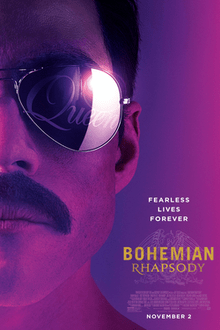
220px-bohemian_rhapsody_poster

Bohemian Rhapsody (2018)
Starring Rami Malek as Queen lead singer Freddie Mercury, Gwilym Lee as guitarist and hair farmer Brian May, Ben Hardy as singing drummer Roger Taylor, Joseph Mazzello as dorky bass player John Deacon, and Branson from Downtown Abbey as Super Bad Gay Dude.

From the moment I saw the trailer for Bohemian Rhapsody, I knew I wanted to see it, even though I have never wanted to see Queen.

My enthusiasm waned when I realized no one could make a movie about Queen without including the dreaded music of Queen. I pictured myself wrapped in a ball beneath my seat while the house speakers pummeled me with “I’m in Love with My Car” (“With my hand on your grease gun/Mmm, it’s like a disease, son”) and “Fat-Bottomed Girls” (“Heap big woman, you done made a big man of me”).

But on a rainy night when our only other choice was Mary Poppins Returns, we grimly fastened our safety harnesses, faced the camera, said, “Let’s do this,” and walked in slow motion into the suburban multiplex while cars and helicopters exploded behind us.

(Is there a musical line I won’t cross? Oh yes, and I know exactly what’s on the other side: Close to the Edge, the Yes biopic.*)

Two and a half hours later, we left the theater wrapped in a happy rock-and-roll daze. What a film! Rami Malek, who had barely heard of Queen before he was hired, resurrected Freddie. When people in the far future envision Freddie Mercury (which they will, despite everything I’ve said about him here in the present), they will think of Rami Malek.

I didn’t like how the film played with Queen’s actual history – Freddie didn’t break up the band by being selfish, Freddie broke up the band by being dead – and there were zero mentions of the glam rock and art rock worlds that birthed them, but I still give this film Four Paws Up for its superlative performances, exceptional sound, and riveting scenes that give us a notion of what it was like to be in the band. The recreation of Queen’s set at Live Aid in 1985 was a spectacle on a level with the “Once in a Lifetime” sequence in Stop Making Sense or the chariot race in Ben-Hur.

Can I do the fandango? Yes, but I prefer not to.

I wanted to see Bohemian Rhapsody because I love films about bands. Naturally, I’ve made a list of all the ones I’ve seen (and some I haven’t). I’ve divided my list into four handy categories (with two subcategories). I don’t claim this list is complete – your nominations are welcome, and will be ridiculed.

Note: Documentaries are off-limits. So no mention of the legions of Beatles docs (such as Imagine: John Lennon and George Harrison: Living in the Material World) or the Decline of Western Civilization movies (punk and metal).

Also, I am arbitrarily striking off all the Star Is Born and Phantom of the Opera movies, including Phantom of the Paradise. This is just too much work.

Ready?

Tonight, Category A:

Biopics about The Beatles

A Hard Day’s Night (1964)
The ultimate band movie, this one about a day in the life of a band that’s very like but not exactly like The Beatles, played by real Beatles. A Hard Day’s Night will not be equaled until they start making fantasy RPG movies where you can be Paul’s grandfather.

Birth of the Beatles (1979)
This was the first movie about The Beatles after their break-up. The songs were recorded by a Beatles tribute band with contributions from Paul McCartney. I don’t recall this film as amounting to much of anything, but it might be nostalgic to rewatch it. We’re probably better off with the next entry, even though like most people I can only handle a finite amount of Pete Best:

Backbeat (1994)
Young Beatles on a rampage in Berlin. The film is only above average, but the soundtrack – ooh-la-la! Alt-rock musicians covering The Beatles covering black R&B hits. Sweet.

Now for Beatles films I haven’t seen:

The Hours and the Times (1991)
Two of Us (2000)
Nowhere Boy (2009)
Lennon Naked (2010)

There are no Beatles songs on these soundtracks. The first two don’t even have songs, just the music that follows the actors around. The other two have some Lennon solo tracks. I can’t claim I’m in rush to see them.

Where are the Ringo movies??

Subcategory: Biopics about bands based on The Beatles

Head (1968)
Correct me if I’m wrong, Princess Internet, but A Hard Day’s Night and Head are the only movies about a band in which the band is played by the band (The Beatles and The Monkees, respectively). Unfortunately for The Monkees, the distance between A Hard Day’s Night and Head is about as wide as the distance between the ceiling of the Sistine Chapel and the bottom of an abandoned swimming pool. A living-room full of stoners would vote to watch Mary Poppins Returns.

The opening track, “Porpoise Song,” is a representative sample of late-’60s psychedelia, but other than that, I recommend you watch The Monkees’ old TV show.

The Rutles: All You Need Is Cash (1978)
The first Beatles parody. My problem with Beatles parodies is that after I hear the first song, I want the real thing. I’m afraid if tonight I watched All You Need Is Cash, I’d be disappointed.

In our next movies-about-music posts we’ll tackle Biopics about non-Beatles, Totally fictional biopics, and Old biopic crud from Hollywood. Until then, we will, of course, rock you.

The song “Bohemian Rhapsody” doesn’t make sense, but, to be fair, neither does “I Am the Walrus.”

* There is no Yes biopic. I just said that to scare you.

This week’s “Letter of the Week” award goes to Loyal Reader Accused of Lurking, commenting on last week’s very exciting post, “The roads less traveled.”

(You did know there’s a “Letter of the Week” competition, didn’t you? It’s a fierce ideological food fight featuring plenty of that groupie-on-groupie violence you readers love. Past winners thought they were going to receive college scholarships, Ducati touring bikes, a fistful of dollars and a handful of God particles, but come on, it’s the thought that counts.)

Accused of Lurking writes:

Had I known that you can’t help but listen to CDs that enter your home, I would have sent you dozens of oddities over the years: one-hit wonders that peaked no higher than 35 in the Top 40, mournful ballads by heavy metal bands, Earth Wind & Fire plays Pachelbel’s Canon, the Deliverance soundtrack, the Grease soundtrack, the Mormon Tabernacle Choir sings Fiddler on the Roof, etc.

It will come as no great shock that I disagree with your assessment of Tunnel of Love. I return to that album on a regular basis. It’s dark. Relationships fail much more often than they succeed. There is plenty of infidelity, mourning, doubt, and just plain agony. But the music and the lyrics carry an incredible power. My favorite songs are “Tougher Than The Rest,” “Two Faces,” “Brilliant Disguise,” and “One Step Up.”

Out of curiosity, I googled “Bruce Springsteen’s best albums.” Tunnel of Love’s ranking within the Springsteen oeuvre is mostly in the #7 to #9 range with a couple of #5s and a #1. Based on my own listening patterns, I put it at #6.

I do, however, agree that The Joshua Tree is a better album than Tunnel of Love.

Thank you as always, Lurk, for jump-starting my brain and making me reexamine my assumptions. So first, here’s a handy flow chart explaining what happens to CDs after they enter my home:

CDs that enter my home always get a listen: True.
All CDs enter my home: False.

Second, here’s what I think of you trying to scare me with all the crud you mentioned: documentation from an estate sale I went to last July.

Arthur Ferrante and Louis Teicher, The Twin Piano Magic of Ferrante & Teicher (1964); Dominic Caruso, World’s Greatest Accordion Hits (1968); 101 Strings, Million Seller Hit Songs of the 50’s (1964). Not shown: Various artists, Percussion for Playboys (1959) and Ann Corio, Sonny Lester & His Orchestra, How to Strip for Your Husband (1963). This was the worst record collection in the Western Hemisphere. (NONE OF IT came home with me.)

Sending me the Grease soundtrack or the Mormon Tabernacle Choir singing Fiddler on the Roof would not make me feel all sunny and wild inside, but at least I know it’s not the worst musical thing that could happen to me.

I would like to hear Earth Wind & Fire play Pachelbel’s Canon.

Bruce Springsteen revisited

I’m not just a simple backwoods music critic, you know. Some people say I’m a handsome Dan; others, a good-lookin’ Joe. Well, it ain’t no secret. I’ve been around a time or two. I admit I walk funny – one step up and two steps back – but that’s because I left my wallet back home in my workin’ pants. I don’t know what I’m wearing now. Jeggings, I guess. Anyway, I went to a gypsy and she swore that a) my future was right, and b) I’m tougher than the rest.

(I actually am tougher than the rest. I survived concerts by The Melvins, The Roches, the undiscovered Nirvana, the underdone David Cassidy, The Rolling Stones being four hours late to a concert in Boston when I was in high school, too many New Year’s Eve bands that forgot the lyrics to “Auld Lang Syne,” and Cher.)

Why do I discount Tunnel of Love? Until Tunnel of Love, Springsteen was writing fiction and occasionally journalism. On this album he dives into memoir. He wrote “Brilliant Disguise” when he was 37. It’s the most painful, personal song he’d written until that time. When I look in your eyes, he asks his wife, who do I see? Who do you see in mine? The words are devastating. Mick Jagger or Keith Richards hitting keys at random on a typewriter keyboard for an infinite amount of time would never have produced “Brilliant Disguise.”

But to my ears, the music doesn’t fit. It’s not devastating; it’s exuberant. It reminds me of Dire Straits’ “Walk of Life.” The lyrics on this disc stick (they’re all over this post), but for me, for intangible reasons, most of the music doesn’t.

Look at this new thing I’ve found

When I read what you’d discovered about fans ranking the Springsteen oeuvre, I immediately made my own list. I figured Tunnel of Love would be way down there. Wrong!

  1. Born to Run
  2. Darkness on the Edge of Town
  3. Nebraska
  4. Born in the USA
  5. The River
  6. TUNNEL OF LOVE

I can’t rank Springsteen’s first two albums ahead of Tunnel of Love because they were, at best, promising. I can’t rank anything from the ’90s ahead of Tunnel of Love because that’s his lost decade. I can’t rank any of his work here in the 21st century, even The Rising, ahead of Tunnel of Love because it’s been years since Springsteen sounded like Springsteen. Despite my best efforts to stop it, Tunnel of Love almost cracks my personal Top 5.

Could it be, Lurk, that you are one face and I am the other, and neither of us can ever make that other man go away? We’re the same sad story, and that’s a fact.

About that pound of caviar you got sitting home on ice: Let’s spread it on some bagels.